Showing posts with label Algebra. Show all posts

Friday, September 11, 2015

Piecing Together the Meaning of The Kansas Teacher of the Year Nomination

I think it was last December when I found out that my good friend Shannon Ralph was named the 2015 Kansas Teacher of the Year! She was/is so deserving! She builds lasting relationships with her students, pushes students to excellence, acts as a leader and role model for our building, and is a huge advocate for education, Biology, and Inquiry Based Learning. That year I was fortunate enough to share a planning period with Shannon, and she pushed me to make huge improvements. During those plan periods we had great discussions about educational theory, technology implementation, and Royals baseball (Mr. Lopez also had the same planning period). It was during these plan periods that we conceived, explored, and planned our Wild West STEM Camp! I will forever be grateful for the time I was able to learn from such a Master! I was so proud and happy when Shannon was named the KTOY because I knew they had chose the right person.


So it came as a great shock when a few months later I was named our district's nomination for the 2016 secondary Kansas Teacher of the Year! Our district is filled with so many great teachers, and I was honored to be considered from a long list of deserving teachers. 

At the time I was working on my last few courses to finish my Master's Degree, and the application for KTOY requires about 22 pages of teaching philosophy, educational issues and solutions, accomplishments, community service, and many other considerations. I really had to dig down deep to write and edit my application while taking six hours of graduate courses, and pour my heart out to my students everyday in class. It was a taxing semester, and I am still not caught up on sleep! In the Spring, I finally submitted my application. 

It has been nearly six months since I submitted my application, and I have been playing the waiting game since then. Tomorrow I will travel to Salina to gather with 30 other teachers to be honored as KTOY nominees. At the luncheon they will announce two finalists from our region to go on and compete for Kansas Teacher of the Year. I am so happy the wait is finally over!

For the last six months my emotions have been a tangled mess. To be honest, I haven't really had a chance to sort through my emotions. Of course, part of me feels happy and proud because I've given my heart and soul to teaching, and it's nice to be recognized for that effort. But, a big part of me doesn't understand this honor. It's not me who deserves or needs any praise. This whole thing is about my students. They are the ones who work their tails off every day. They are the ones who are inspiring. They are the ones who buy-in to all the quirky things I do in my classroom. They are the ones who own the future. I wish they could all be there tomorrow and be recognized for being awesome. They deserve it!


In addition, I'm not convinced I'm the best teacher in my hall, let alone the math department, the school, the district, or the state. I am so lucky to work with some amazing and inspiring teachers who push me to learn more and improve my craft. Again, they are the ones who deserve recognition! I would be a broken down, shell of a teacher crying in the corner without the other amazing teachers who inspire me on a daily basis. 

So, for quite some time, I've been toying with the question, "what does this all mean?" What is the significance of this KTOY honor? On the eve of the luncheon, I think I am finally getting a grasp on what this all means. I look back at the second blog post I ever wrote, and I think the answer is found somewhere in the words I wrote three years ago! The blog post was titled It Takes A Village (you can read it here: http://coffeyhousemath.blogspot.com/2012/08/it-takes-village.html). To me the significance of this honor is that I am a valued piece of a giant puzzle. It feels great to know that I fit perfectly along side my peers. It feels great to know that the puzzle wouldn't quite be complete without me. But, this puzzle isn't about one piece. This puzzle is about hundreds of pieces coming together at the right time in the right place to make something beautiful. From the administrators who took a chance on hiring a retail manager to teach Algebra, to my principal who grants me liberties and allows me to use bouncy balls instead of chairs, to my instructional coaches who have consoled me through tears and frustration, to my teacher friends who give me ideas and books and inspiration to improve, to the custodians who clean the GIGANTIC messes we make in my classroom with M&Ms, PVC pipe, and ice cream (without ever complaining), to the bus drivers who safely deliver me students every day, to the Paraprofessionals who work tirelessly to translate, accommodate, and care, to the parents who work to provide for our students, to our community members who use their votes to voice their support for providing a quality education for students, to the students who buy-in to the idea that they can grow and improve themselves through hard work and effort.


It's a beautiful puzzle. Each piece provides support to other pieces. When you step back, you can get a view of the whole picture and the individual pieces fade into one master piece. I'm so excited to be a piece of that puzzle. I appreciate that the KTOY program recognizes pieces of the puzzle; that's important. But, they're just pieces of something bigger. I think I gain more satisfaction from the idea that I am a part of something bigger. What a cool job I have!


Sunday, July 27, 2014

Three Takeaways from Podstock

I was introduced to Podstock through my friend Ginger Lewman (@GingerLewman) during some Project Based Learning training. I went home, did some research about Podstock, and I started gaining an interest. Soon, my Twitter feed was consumed with talk about Podstock! As I began talking to my professional learning network and learning more about the conference, I knew I had to go!


Technically, Podstock is a technology conference for educators and administrators. However, those who have attended the "family reunion" know that the conference is much more about transforming education into something real and inspiring for our students. Thankfully I work in a school district who values teachers who want to learn, and they sent me and twenty-eight other teachers and administrators to Wichita to learn! 


The Podstock experience was inspiring, motivating, and full of boundary pushing challenges. At Podstock I wanted to participate in every extra-curricular event (I attended Moonlight Madness, I took second place in a pinewood derby race, attended a dance, dressed in costume, participated in a gift exchange, took photos during an early morning photo walk, and my team won the social scavenger hunt)! That was A LOT to do in two days! In addition, I wanted to listen, share, and learn from every conversation going on at the conference. I tried to use my time to ask questions, make connections, and improve my craft in the classroom. Those two days completely blew my mind, and it has taken my brain an entire week to pick up the pieces and put things back together. Although I learned an insane amount from my first Podstock experience, I wanted to take a moment to reflect on my three biggest takeaways from Podstock 2014!


The first thing I noticed at Podstock was the transformational vibe. Everywhere I looked I found educators using technology to completely transform the educational experience for students. These teachers weren't switching from analog to digital worksheets. They were connecting their students to students on the other side of the globe; they were transforming their classrooms into hospital rooms; they were allowing students to plan, design, and create while learning. What I learned is that emailing an assignment to my students instead of passing out a paper copy isn't using technology to its fullest potential. This year, I want to focus on finding creative ways to utilize technology to the fullest. I want to create educational experiences which will leave a lasting impression on my students. I want to use technology to inspire and motivate my students. I want my students to feel the same vibe I felt when I walked through the Podstock phone booth!


Another takeaway I had from Podstock was the phrase "learn to love to learn." As far as I know, Kevin Honeycutt (@KevinHoneycutt) coined this phrase. I say that because I was fortunate enough to sit next to Kevin during the "Flip Like a Ninja" session put on by Todd Nesloney (@TechNinjaTodd), and Kevin had the phrase tattooed all over his laptop! This notion was laced throughout the sessions I attended during the two day conference. Todd Nesloney talked about it during his keynote. He talked about how students should be running to school because they are so excited about what they might learn that day. I think school starts out that way for many students, but somewhere along the way the grind of school buries that excitement somewhere deep inside. I like this idea of learning to love to learn because of the growth mindset mentality. I think we all love to learn as long as we are learning about things that are important to us. What's trickier is to get a 15 year old to learn to love to learn about quadratic equations. However, for me, Podstock drove home the point that if I teach with passion and enthusiasm, and I give my students the opportunity to pursue their passions through our curriculum, then students will be running to my classroom to learn, build, and create using mathematics. As the start of a new school year rolls around, I want to be mindful that one of my goals should be to help my students reach the point where they learn to love to learn.


Over the Fourth of July, I spent a week in Minnesota at a family reunion on my Mom's side of the family. My family reunions aren't your typical family reunions because they center on education! I'm a high school math teacher, my wife is a kindergarten teacher, my Grandpa Bill spent much of his life working for North Dakota State University, my mom is a college professor, my aunt Beth is a member of the local school board, my aunt Patty is a Physical Education teacher, and my aunt Barb is an Instructional Coach. Not to mention, my cousin Lindsay teaches dance, my cousin Alex is a school counselor, and my brother and his wife home school their four children. And this is just my Mom's side of the family. There are just as many educators on my Dad's side of the family! Education, quite literally, flows through my veins! Anyways, when we get together, our conversations always turn to education. Even when we try to talk about sail boats and jet-skis, somehow our conversations naturally move towards education. Well, I always hear people say that "Podstock isn't a conference, it's a family reunion." For me, I think they are right on! Just like my family reunions there are tons of laughs, there are super deep conversations, there are disagreements, there are debates, there are more laughs, there are hugs, there are tears, there is fun, there are late nights and early mornings, there is food, there are competitions, and there is never enough time. That sums up my Podstock experience; it was an intense two day family reunion. My final takeaway from Podstock is that I am part of an enormous family of educators who are pushing and striving to better our educational system, to better or schools, but most importantly to better our students.


Tuesday, July 15, 2014

Three Takeaways from Teach Like A Pirate

Teaching is a great job! The rewards of teaching are plentiful! One of the great rewards of teaching is summer. I know what you're thinking, "Here's another teacher bragging about having summers off." Let me assure you, that is NOT where I am going! I love summers because they give me a chance to step back, re-evaluate, study, and improve my craft. Can you imagine if all careers gave workers a small break to catch their breath, re-evaluate what they're doing, and give them a chance to seek more training? Can you imagine how much more productive workers would be when they got back from their "break?"

My son Blain driving the boat with my cowboy hero uncle.

This summer I am taking part in a Summer Learning Series (#SummerLS) put on by Todd Nesloney (@TechNinjaTodd). Mr. Nesloney is entering his first year as a principal in Texas. The learning series was intended to be a voluntary challenge for Mr. Nesloney's new staff. However, it has transformed to a learning challenge with over 1700 teachers from 13 different countries participating! Each week throughout the summer, Mr. Nesloney sends out a challenge, and participants work during the week to complete the challenge and report back their results. A few weeks back, one of the challenges was to read Teach Like A Pirate by Dave Burgess (@burgessdave). By a stroke of luck, some leaders in my district were doing a book study on the Teach Like A Pirate book, and my Assistant Superintendent gave me a copy of the book to borrow. How lucky am I to work for a district who strives to be on the cutting edge of education, and a district who is always willing to help teachers?!?!

Now here's a treasure worthy of a pirate's quest!

From the opening page of Teach Like A Pirate, I was hooked! I learned so much from the book, and was re-inspired by Dave Burgess's energy! I can hardly wait for students to come back to my classroom! Here are my three take-aways from Teach Like A Pirate.

The first thing that I learned from Teach Like A Pirate is that I am lacking in passion and enthusiasm. Now, don't get me wrong, I have a great deal of passion for math and learning! However, I've been holding back. I haven't been very enthusiastic, and I haven't let that passion shine. I've been too shameful. I've thought, "What if my students think I'm a weirdo? What would my colleagues think if I let all my enthusiasm loose?" Dave has helped me realize that my students' futures are too important to hold back my passion and enthusiasm! I think Garth Brooks said it best when he said, "I'M SHAMELESS!" Who cares if my students think I'm crazy? I am crazy! Who cares if my colleagues hold up their nose? When it comes down to it, I think they would want their own children in my Algebra class! I need to be shameless when it comes to using my passion and enthusiasm in my classroom.

The second thing I took from Dave's book is the idea of immersion. Dave's idea of immersion is to completely give yourself up to the moment and fully be with your students. I would love to say that I am fully immersed in my classroom everyday, but I would be lying. Too often I get caught up in checking my e-mail, grading papers, or letting my mind wander. How can I expect to keep my students' full attention in class when there are times I can't even keep my own full attention on class! My students deserve my full immersion in class, and I appreciate Dave calling me out on that point.

My final take-away from Teach Like A Pirate is to not be ashamed of thinking of my classroom as a place of edutainment. I have heard teachers say, "I am paid to educate these children, and not to entertain our students." I have also heard teachers in my department say, "Math class is not supposed to be fun." I have always disagreed with those statements, but hearing those comments put a seed of doubt in my head. In his book, Dave helped me realize that I don't have to apologize for making math class fun or finding creative ways to entertain my students. In fact, separating education and fun is dangerous! When I observe my son learning, it is always while he is having fun. He learns through play; he learns through games; he learns while doing things he enjoys. Although my students are a bit older, they learn though the same processes. Along with helping me come to terms with being an edutainer, I loved the way Dave wrote about creativity. He talked about how creativity is developed through hard work (I love the growth mindset undertones). I really appreciated the advice about how to create a system to capture ideas. I am going to use my iPhone and iPad to help me capture ideas as they come to me!

I am very grateful for the opportunity to step away from the every day hustle and bustle of the classroom, and re-calibrate my classroom GPS over the summer. The summer is a great time time to examine the desired destination of your classroom and program your GPS to get you to that desired location. Teach Like A Pirate has helped me set my GPS, and I believe the payoff will be less time stopping to ask for directions once we hit the road this fall!


Wednesday, May 21, 2014

A Growth Mindset

Sometime between my day dreams of fishing trips and the reality of grading papers, the last day of school has come and passed. The sixth chapter in the book of my teaching career has been written, and I think the last day of school is a perfect opportunity for reflection.


Recently, I have been exploring the idea of a "growth mindset" versus a "fixed mindset." In case you haven't read Dr. Carol Dweck's research, here is my short version of the difference:

A person with a fixed mindset believes their abilities, intelligence, and talents are fixed. People with this mindset say, "I'm just not good at math; never have been, never will be." A fixed mindset will use challenges and obstacles as an excuse to quit trying because they are afraid of failure or being perceived as "dumb."

On the other hand, people with a growth mindset believe that abilities and talents can be developed through effort, hard work, and persistence. Rather than being fearful, people with a growth mindset, see failure as an opportunity to learn and improve. People who seek challenges and maneuver around obstacles are said to have a growth mindset.

As I studied these types of mindsets, I started hearing my students use fixed mindset phrases on a daily basis. I started seeing the correlation between their fixed mindset towards school (and specifically math) and their poor effort in the classroom. I heard my students say, "Mr. Coffey, I just don't get it. I give up. I'm just not good at math." Unfortunately, someone put these thoughts in my students' brains (either directly or indirectly). My students are picking up this fixed mindset from parents, friends, the media, and dare I say, teachers. I decided that I can no longer allow this fixed mindset in my classroom, and I am making a commitment to helping my students develop a growth mindset.


The task sounds daunting, maybe even impossible. That is because you are reading this with a fixed mindset. Stop it! Towards the end of this school year I helped my students rephrase their fixed mindset phrases. Instead of saying, "I don't get this," I stopped them and made them repeat, "I don't get this yet." Instead of saying, "I don't like math," I made them rephrase to "I haven't liked math yet." I would have thought that my students would brush off my little added word, but I could honestly see a difference in their attitude when I forced them to rephrase their fixed mindset phrases. It's like I magically tricked their brain with one little word. If you don't believe me, I challenge you to try it. Next time you hear a fixed mindset phrase, ask the person to repeat the phrase with the word "yet" added to the end. Watch the change in their facial expression when they allow themselves room for growth. You can literally see the change in their face.

I'm not saying I drastically changed the lives of all my students by adding three letters to their statements; some students are stuck deeper in the fixed mindset rut. They are going to need more discussion, more examples of successful people with growth mindsets, and proof that they can grow taller than the obstacles their minds have created. But, I did see a change, and that was with minimal effort.

The great thing about a growth mindset is it spills over the classroom walls. A growth mindset can change, "my mom and I don't get along," to "my mom and I aren't getting along right now." It can change, "we are poor," to "we don't have much money at the moment." And, those little changes can open a lot of doors while offering some much needed hope.


As I sit in my empty classroom, and contemplate the good and the bad of this past school year, I believe I can make next school year more successful by addressing mindset early and often. My students need to know that "Neither success nor failure is ever final." You can be on the highest high, but that doesn't mean you can stop growing because we've all witnessed top dogs fall to the bottom. You may be at the lowest low, but that doesn't mean you should stop growing because we've all seen the underdog end up on top! For me, it's about giving students permission to make mistakes. It's about giving students permission to fall down. But most importantly it's about giving my students permission to knock down walls and push themselves to grow.

Tuesday, April 1, 2014

Hey, You Should Make Your Math Class Fun

When you're a math teacher, introductions can sometimes get awkward! After the handshakes, smiles, and usual small talk, the question is always asked. "So Justin, what do you do?" Once this question is asked, I can predict the next twenty minutes of dialogue. It never changes.

"Oh, wow, a math teacher eh? I hated math in school. I was never very good at it. Thank goodness I've never had to use it! Hey, you know what you should do? You should make your math class fun. My class was always so boring. Also, you should stop teaching them useless math like Algebra, and start teaching them math they'll actually need in real life. You know what I mean?"

Stop smiling. There's no smiling in Algebra class!!

I have never met a person who has said, "Oh, awesome! That sounds like a great job! I would love to teach Algebra to high school students! Do you know of any openings?"

The truth is I do have the greatest job on Earth, and I would never trade for another (except maybe an astronaut, but then that's not really a job "on" Earth). If they only knew... 

Their advice sounds so simple. Make math fun. It's like people actually believe that math teachers sit up at night asking themselves, "This lesson is okay, but how could I make this just a little more boring...?" Here's the truth: every math teacher I have ever met (and I've met a lot) is desperately searching, researching, clawing, and fighting for "fun" math lessons. And, they are out there; I've seen them. I'm working on adding more and more "fun" to my Algebra class, but it's a process, and it takes time, energy, and resources. Unfortunately, none of those are unlimited!

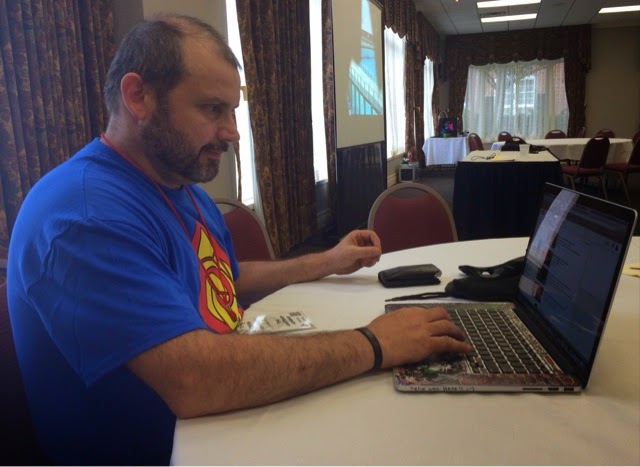
Please don't wear this shirt.

The other thing I hear (nearly everyday) is, "I never use Algebra, and I turned out fine." I have to bite my tongue. I want to say, "You drove your car here without running out of gas didn't you? You know how many bags of Cheetos you could buy with $10 don't you? You used a car loan to purchase that new truck didn't you? You're investing in your retirement aren't you? Heck, even the people who designed that funny little shirt you're wearing used Algebra to ensure their text was centered and the font size was optimized to ensure maximum readability." But, those arguments are best left unsaid because then the next line coming is, "Well, that's not really math..." But the truth is math is all around us and our brain is making constant calculations to keep us safe and happy. Most of those calculations are done unconsciously; not because it's not really math, but because you probably had math teachers who stayed up late at night wondering how they could exercise that mathematical portion of your brain the next morning.

Catapulting pennies onto targets

I have digressed. Here's my point: I was part of an amazing training today about Project Based Learning, and I am more excited than ever to put the fun in Algebra class! I have done "projects" in class, but I am a newbie to the whole PBL strategy. I think I have a plan to mesh my current blended classroom with a dynamic, exciting Project Based Learning classroom. I also think Ginger Lewman (an educational guru) has a similar message to all those strangers I have met. If I hook my students with a "tasty" project they are dying to get their hands on, I will be amazed at the lengths my students will go to in order to learn the skills necessary to make a totally rad project. Give them a reason to get excited and fall in love with math. Make it fun. 

Stay tuned to share in my mistakes, insights, and triumphs!

Thursday, March 6, 2014

Down the Rabbit Hole of Blended Learning

Lately I've been feeling a bit like Alice falling deeper and deeper down a crazy rabbit hole called "blended learning." I had heard of this madness called blended learning, but I had never explored or thought too deeply about its possibilities. That is, until I stumbled upon Moodle, seemingly by accident.


My trip down the blended classroom rabbit hole started out with the idea of "flipping" my classroom. I read some research; I did some homework; and I started my adventure by video recording my lessons. I was content that my students could access my lectures at anytime, my absent students could stay caught up, and I was putting the responsibility of learning back on the students. At this point, I was uploading my videos to YouTube and sharing the link on my classroom website. To share assignments, I experimented with Google Drive. To administer quizzes, I played around with Socrative. All of these apps and programs were working well, but I was missing some cohesion. I was searching for a platform that could host all of my needs. 


One day while sharing stories and experiences with another teacher (a total teaching rock star) who is "flipping" her classroom, she mentioned using Moodle in her classroom. Since that moment my classroom hasn't been the same! I quickly bombarded her with questions. I had heard of Moodle. My mom (who has been a great inspiration, coach, and sounding board) is a professor of nursing, and has been raving about the use of Moodle in her courses. I knew that Moodle could offer me the cohesion I was searching for in my classroom.

Without much effort my Moodle site was up and running. The more I experiment and tinker with Moodle, the more confident I am that I can offer my students a learning experience tailored to their style of learning and technology culture. Moodle has allowed me to truly transform my classroom into a blended learning environment. 

For each module in my course, I am able to share videos of my lectures, pdfs of textbooks, practice sets, notes, and assignments electronically. Essentially, my students are taking High School Algebra "online." Except it's better than an online course! Because my students have access to all "nuts and bolts" at their fingertips 24/7, we are able to spend our classroom time clearing up any misconceptions, working in small groups or one-on-one, and taking our knowledge and applying it to real world applications. I create a quiz at the end of each module from a test bank of questions. If the student scores an 80% or above, then they are awarded an electronic badge to signify their mastery of that particular module. If the student scores below an 80%, they are asked to go back to their notes, re-watch the lecture, re-read the text, or come in during study hall to receive extra help from myself or a math tutor in order to correct their mistakes. Then, they are asked to retake the quiz until they earn an 80% or higher. This model for learning has worked great so far, and I believe it will only get better as I gain more experience and find solutions to minor issues.


Looking out from the inside of this rabbit hole it all seems to make sense. Blended learning is taking the very best benefits of online learning and combining them with all the very best benefits of "brick and mortar" learning. We have to remember that this generation of learners don't simply listen to the radio; they choose what song they want, and when they want it. This generation of learners don't simply watch TV; they choose what show they want to watch, record it, and watch it when they want it. Why would they expect anything different from their education? I have come to the realization that this generation of learners is the generation of personalization and choice. For this reason, I believe Moodle grants me the opportunity to create a blended learning environment that is both relevant and effective to today's learners.

Wednesday, February 26, 2014

More Technology, More Problems (and More Triumphs)!

Sometime back, our local school board had an important meeting. After deep thought, careful calculations, and probably some nifty marketing by a company named Apple, our board voted to move forward with a plan to put in an iPad in the hands of every student in our school district. Yes. Every. Student. In Dodge City, Kansas, the innocent hands of kindergartners, the awkward hands of middle schoolers, and the "too cool for school" hands of high schoolers all hold a small tool capable of displaying the big world on a nifty nine inch screen.

I received my iPad a little over a year ago. The district wanted to give teachers a head start with the new technology, so we were given a year to play, discover, and plan. As an educator I was excited to know that my students would have the world at their fingertips. I didn't exactly know how I was going to use the iPad in the classroom, but I knew it was a game changer. I've always considered myself to be kind of a tech savvy guy, but with each passing year I can feel technology pulling further and further ahead of me. I've found myself gripping tight to my mouse while the world around me has moved on to touch screens and finger swipes. 

Nonetheless, I volunteered to be on the "iPad Deployment Team" at my school in January. It would be my job to introduce the students to their iPad. It was a moment that I wanted to witness and be a part of. I wanted to see their reactions. I wanted to see their comfort level. I wanted to learn from them. The process of handing out and doing some initial set-up on 1,800 iPads took 9 days. There were a couple moments of deep frustration, but for the most part things went smoother than I could have imagined.


Our students have had iPads for two months now. I have gone full circle through the emotional ringer. There have been moments of pure excitement and moments of pure torture and frustration. There have been moments where I have felt like finding a sturdy shovel, digging an enormous hole, and burying 1,800 iPads. Students have been playing games, snap chatting, and making absurd sounds with their iPads. Holding the attention of a 15 year old while you lecture about equations written in vertex form is difficult enough; but when you add the distraction of an iPad, the task has become darn near impossible.

Despite the difficulties, I have been planning, collaborating, studying, and working non-stop to somehow find a way to make these iPads work in my Algebra classroom. We have experimented with different apps. I have tried new techniques. And, we have talked extensively about iPad etiquette. 

Two weeks ago things suddenly became very clear to me. The honeymoon fog was lifted, and I was left with a very precise vision of how my classroom should be ran to make effective use of the iPads. Not only that, but I am also finding ways to tap into the "gaming" culture which has been embedded in my students' lives since they were two years old. I am also experimenting with new ways to customize the classroom for each individual student. All of this change has come very sudden, and I am still working out a few kinks; however, I have never felt so confident and secure about the direction of my classroom. I have a new found passion and excitement to give my students what they have been longing for, a style of learning which fits their lifestyle, culture, and individual needs.


I have been amazed at the changes I have seen in my classroom in the last two weeks. I am excited to share my victories and setbacks in this journey into the land of iPads. I hope to use my blog as a platform to share ideas and gather advice and input as I continue to search for ways to improve the classroom experience for my students.